



Recently, the European Commission officially published Commission Regulation (EU) 2026/1120 in its Official Journal. This Regulation amends Annex III to Regulation (EC) No 1107/2009, the core regulation on plant protection products in the EU, by formally adding 12 substances to the list of “unacceptable co-formulants” that are banned from inclusion. This means that authorizations for plant protection products and adjuvant mixtures containing these substances must be withdrawn or amended by June 16, 2028.
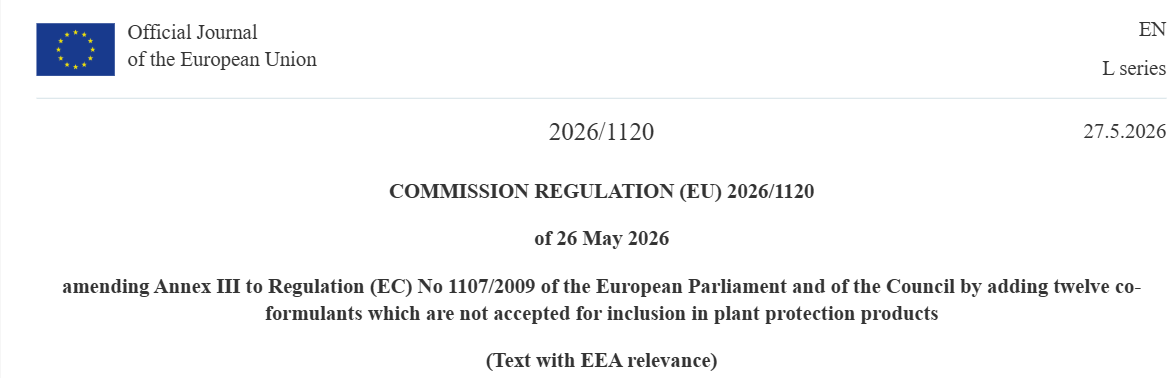 Image source: EUR-Lex
I. Regulatory Background
Within the EU regulatory framework, pesticide co-formulants are defined as components of plant protection products or adjuvant mixtures other than active substances, safeners, or synergists. If a certain type of co-formulant is identified through scientific assessment as posing harmful or unacceptable risks to human health, animal health, or the environment, it will be included in the list of unacceptable co-formulants in Annex III.
In recent years, the EU has continuously tightened its regulation of co-formulants in agrochemical products. The 12 substances newly added to the banned list this time are all substances of high concern identified by Member States pursuant to Commission Implementing Regulation (EU) 2023/574. Due to their severe health or environmental hazards, they have been formally slated for phase-out by the European Commission.
II. Overview of the Newly Banned Co-formulants
The 12 co-formulants banned in this update were not selected at random; the majority have been identified as carcinogenic, mutagenic, or toxic for reproduction (CMR Category 1A/1B), while the remainder are persistent, bioaccumulative, and toxic substances (PBT/vPvB) or persistent organic pollutants (POPs).
Annex: List of the 12 Newly Banned Co-formulants
Substance | CAS No. | Reason for Ban / Classification |
Acetaldehyde | 75-07-0 | Carcinogen Cat. 1B |
Propylene oxide | 75-56-9 | Carcinogen Cat. 1B / Mutagen Cat. 1B |
Cumene | 98-82-8 | Carcinogen Cat. 1B |
Dodecamethylcyclohexasiloxane(D6) | 540-97-6 | PBT / vPvB |
Decamethylcyclopentasiloxane(D5) | 541-02-6 | PBT / vPvB |
Octamethylcyclotetrasiloxane(D4) | 556-67-2 | PBT / vPvB |
2-(2’-hydroxy-3’-tert-butyl-5’-methylphenyl)-5-chlorobenzotriazole | 3896-11-5 | vPvB |
Distillates (petroleum) solvent-dewaxed light paraffinic with a content of ≥ 3,0 % DMSO-extract (measured by IP 346) | 64742-56-9 | Carcinogen Cat. 1B |
3,5,7-Triaza-1-azoniatricyclo[3.3.1.1 3,7 ] decane,1-(3-chloro-2-propen-1-yl)-, chloride | 4080-31-3 | Not approved for use in biocidal products of PT6 (in-can preservatives) |
Phosphinic acid, bis(perfluoro-C6-12-alkyl) derivatives | 68412-69-1 | Persistent organic pollutant (POP) |
1,4-Dioxane | 123-91-1 | Carcinogen Cat. 1B |
2-(4-tert-butylbenzyl) propionaldehyde | 80-54-6 | Toxic to reproduction Cat. 1B |
The initial reaction of many companies upon seeing a banned list is to check their formulation sheets to confirm whether they have intentionally added these substances. However, the regulation’s provisions regarding impurities are equally strict: if these banned substances are present as “unintentionally added impurities” in other compliant co-formulants, their concentration in the finished product must be below 0.1% (w/w). However, if a lower specific concentration limit has been set for that substance, that lower limit shall apply. Once this limit is exceeded, the substance will no longer be considered an acceptable impurity, and the relevant products may face compliance risks.
III. Authorization Withdrawal Dates and Grace Periods
The publication of this Regulation will directly affect the legality of plant protection products and adjuvant mixtures exported to the EU. According to Articles 2 and 3 of the Implementing Regulation, for plant protection products or adjuvant mixtures containing these 12 co-formulants that have already been authorized on the market, Member States must amend or withdraw the relevant authorizations as soon as possible, and by June 16, 2028 at the latest.
To minimize the impact on the supply chain, the EU has granted limited transitional grace periods:
· Sale and distribution: The grace period for the sale and distribution of the products concerned shall not exceed 3 months after the withdrawal of the authorization;
· Disposal, storage, and use: The grace period for the disposal, storage, and use of existing stocks shall not exceed 12 months.
In other words, counting from June 2028, companies will have a maximum of 15 months in a complete cycle to deplete inventory and transition their supply chains, with an even shorter window for sale and distribution. Given the sequence of steps involved—formulation screening, process validation, stability testing, applications for registration amendment, and evaluation queues—the two-year buffer period is not particularly generous.
IV. Compliance Recommendations for Enterprises
In light of the latest changes in the EU’s regulatory policy on co-formulants, it is recommended that relevant agrochemical enterprises take the following measures:
· Conduct a comprehensive screening of existing formulations: Enterprises should immediately check the production processes and formulations of products currently exported to the EU to confirm whether any of the 12 newly banned co-formulants are directly used.
· Strictly control the risk of impurity carry-over: Verify raw material specifications with upstream suppliers to ensure that residues of banned substances introduced by manufacturing processes remain below 0.1% or the stricter limits required by relevant regulations.
· Initiate alternative R&D: If products are affected, compliance and R&D departments should initiate formulation adjustments and the screening of eco-friendly alternative co-formulants as early as possible, and prepare the corresponding amendment application documents.
REACH24H will continue to track EU regulations on plant protection products and provide customers with professional compliance information and strategic advice.


Most Popular
- 1 Brazil Launches Sispa: A Unified Digital Platform for Pesticide Registration
- 2 South Korea Issues Guidelines on Establishing Biocidal Product Names, Clarifying Rules on Identical Names, Additional Names, and Prohibited Expressions
- 3 Vietnam to Officially Abolish Quality Pre-Inspection for Imported Fertilizers Starting July 1
- 4 EU Imposes Strict Regulatory Measure: 12 Pesticide Co-formulants Added to Banned List
- 5 California Releases New Regulation on Groundwater Protection List: Added 51 New Active Ingredients