



Recently, the California Department of Pesticide Regulation (DPR) released the final regulation to update the Groundwater Protection List (GWPL). The regulation will officially take effect on July 1, 2026, marking the formal entry of California's groundwater pesticide regulatory system into the era of "multivariate risk assessment."
This amendment aims to improve the efficiency of groundwater contamination monitoring through a more scientific and precise assessment methodology, and concentrate regulatory resources on pesticide active ingredients with the highest potential risks.
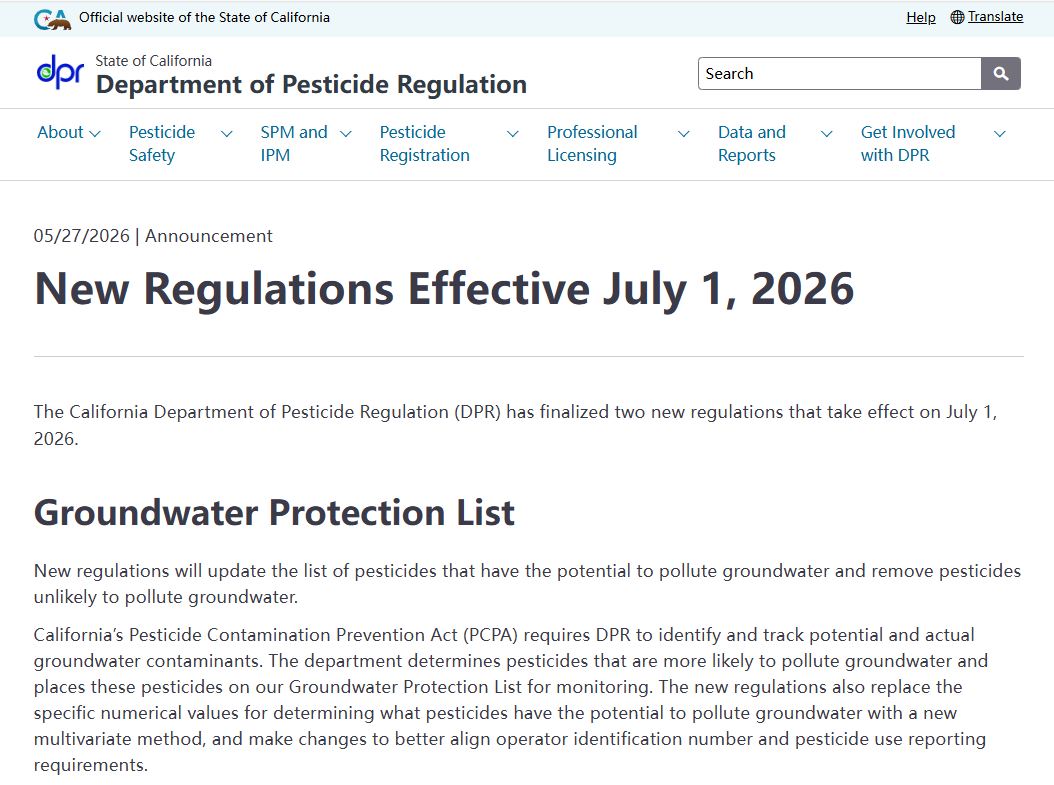 (Source: CDPR)
Why Does California Place Such High Importance on Groundwater Contamination by Pesticides?
As a major agricultural state in the U.S., California has long faced environmental pressure on groundwater caused by high-intensity pesticide use. Since groundwater is directly related to the safety of residents' drinking water and the stability of agricultural ecosystems, California passed the landmark Pesticide Contamination Prevention Act (PCPA) back in 1985. Pursuant to the requirements of this act, DPR established the Groundwater Protection List (GWPL) to identify and track potential and actual groundwater contaminants. Once an active ingredient is listed on the GWPL, it means its agricultural use in California will be subject to more stringent regulation.
Four Core Changes of the New Regulation
(1)Introduction of the New "Multivariate Leaching Value (MLV)" Assessment Method
DPR has formally introduced the "Multivariate Leaching Value" model to evaluate the potential risk of pesticide active ingredients entering groundwater. Unlike the previous reliance primarily on Specific Numerical Values (SNVs) (such as water solubility, soil adsorption coefficient, or half-life), the new model will comprehensively consider multiple environmental behavior parameters, thereby assessing the actual leaching risk more accurately.
(2)Restructuring of the Groundwater Protection List
DPR has reclassified the structure of the existing GWPL into three parts to more clearly differentiate pesticide active ingredients in different regulatory statuses:
·Subsection (a): Active ingredients and/or their degradation products, including their salts and esters, detected in groundwater or soil due to legal agricultural use (7 active ingredients in total, such as atrazine, simazine, bentazon, etc.);
·Subsection (b): Pesticide active ingredients and/or their degradation products, including their salts and esters, that have completed the formal review process and been incorporated into the groundwater monitoring system (5 active ingredients in total, such as imidacloprid, metolachlor, etc.);
·Subsection (c): Active ingredients and/or their degradation products, including their salts and esters, determined to have groundwater leaching potential under the new MLV assessment method and requiring preventive monitoring. Relevant substances previously listed under the old Specific Numerical Values (SNVs) have been uniformly transitioned and integrated into this section (107 active ingredients in total, such as chlorantraniliprole, clopyralid, etc.).
(3)51 New Active Ingredients Added, Total List Count Adjusted to 119
Based on the brand-new MLV assessment system, this new regulation has comprehensively updated the GWPL, with the latest list total adjusted to 119 active ingredients. Among them, 51 new active ingredients have been added to the Subsection (c) preventive monitoring list, including 1,3-dichloropropene (1,3-Dichloropropene), paraquat (Paraquat dichloride), etc., which have drawn wide industry attention. Meanwhile, some substances that are no longer registered in California, or are identified as having a low leaching risk after re-assessment, will be removed from the GWPL.
(4)Better Align Requirements for "Operator Identification Number" and "Pesticide Use Reporting"
After the implementation of the new regulation, land/crop operators will be required to fill out information in accordance with the restructured GWPL classification when applying for the operator identification number (OID) and submitting monthly pesticide use reporting (PUR) to ensure that groundwater monitoring data can be accurately tracked and aligned.
What Does It Mean for Agrochemical Companies?
For companies that sell or register pesticide products in California, this regulatory adjustment has a strong practical impact. If a product contains an active ingredient newly included in the GWPL, the company may face:
More stringent regulation of groundwater risks;
Increased label restrictions;
Restricted areas of use (specifically in Groundwater Protection Areas, GWPAs);
Higher frequency of on-site sampling and monitoring.
Compliance Recommendations: How Should Companies Respond?
As a professional EPA and California pesticide registration agent, REACH24H Consulting Group recommends that relevant companies conduct product self-inspection as soon as possible, check their products against the latest GWPL list to confirm whether they involve the newly added high-risk active ingredients, and keep a close eye on subsequent changes that DPR may introduce regarding use restrictions in groundwater protection areas, labeling requirements, and reporting obligations. Meanwhile, communication with local distributors, growers, farm operators, and pesticide applicators should be strengthened to ensure timely understanding of the latest compliance requirements for OID and PUR.
The approval of the new GWPL regulation marks California's entry into a more precise "multivariate risk assessment" phase for groundwater pesticide regulation. Relevant companies should conduct compliance evaluations and product reviews as early as possible to mitigate subsequent market access and regulatory risks.
For further information regarding California pesticide registration, groundwater regulation, and product compliance requirements, please feel free to contact REACH24H Consulting Group. REACH24H has long been focusing on US EPA, California DPR, and global pesticide registration, providing companies with one-stop solutions including regulatory consultation, registration submission, and compliance support.



Most Popular
- 1 EU Imposes Strict Regulatory Measure: 12 Pesticide Co-formulants Added to Banned List
- 2 Vietnam to Officially Abolish Quality Pre-Inspection for Imported Fertilizers Starting July 1
- 3 EU Advances TFA Hazard Classification: Companies with Fluorinated Pesticide Portfolios Should Assess Metabolite Compliance Risks Early
- 4 South Korea Issues Guidelines on Establishing Biocidal Product Names, Clarifying Rules on Identical Names, Additional Names, and Prohibited Expressions
- 5 California Releases New Regulation on Groundwater Protection List: Added 51 New Active Ingredients