



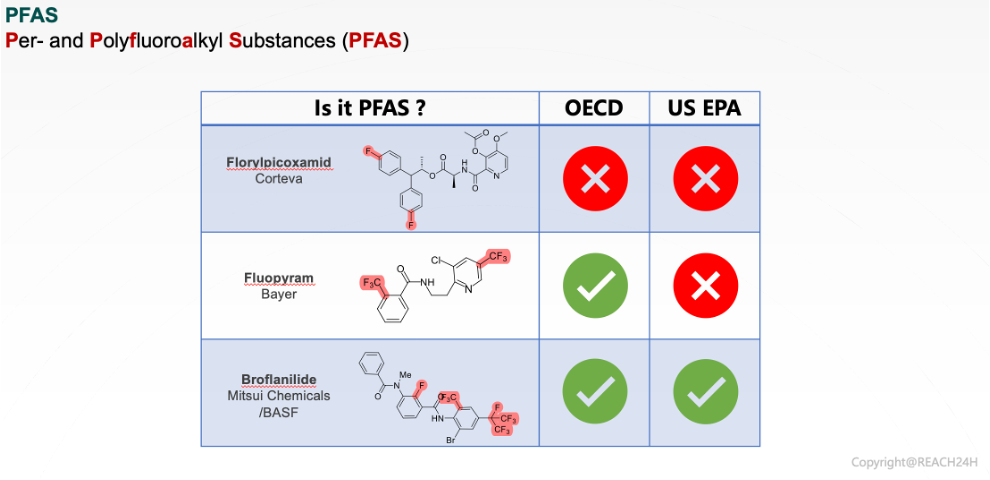
In recent years, fluorine-containing pesticides have become the absolute mainstream in new pesticide R&D, thanks to their high efficacy, low toxicity, and high selectivity. According to statistics, between 2010 and 2022, fluorine-containing pesticides accounted for as much as 64% of newly launched pesticide varieties worldwide, far ahead of non-fluorine varieties (23%) and those containing other halogens (13%). Fluxapyroxad, fluopyram, broflanilide... these well-known star products all carry the "fluorine" label.
However, when "fluorine-containing" shifts from an R&D advantage to a regulatory label, agrochemical companies are now facing an unavoidable compliance challenge — the PFAS regulatory storm.
What Are PFAS, and What Do They Have to Do with Pesticides?
PFAS (Per- and Polyfluoroalkyl Substances) is a collective term for a class of fluorine-containing organic compounds. Because of their extreme environmental persistence, they are known as "forever chemicals." Among them, perfluorinated compounds such as PFOA and PFOS have already been strictly regulated due to their carcinogenicity and bioaccumulation (IARC has classified PFOA as a Group 1 carcinogen).
But the problem is — there is still no globally unified definition of PFAS, and this uncertainty is now spreading into fluorine-containing pesticides.
The two most mainstream definitions currently in use:
· OECD (2021):
· The molecule contains at least one fully fluorinated methyl group (-CF3)
· The molecule contains at least one fully fluorinated methylene group (-CF2-), in which the carbon atom is not bonded to H, Cl, Br, or I atoms
· U.S. EPA (2023):
A chemical substance containing any of the following three structures:
· R-(CF2)-CF(R')R'', where both CF2 and CF are saturated carbon atoms
· R-CF2OCF2-R', where R and R' are F, O, or saturated carbon atoms
· CF3C(CF3)R'R'', where R' and R'' are F or saturated carbon atoms
This means that the same pesticide variety may lead to entirely different conclusions under different definitions.
Three Layers of Regulatory Pressure Companies Must Know
1. EU PFAS Restriction Proposal
ECHA has put forward a broad restriction proposal covering all uses of PFAS. Unlike traditional risk assessments, the proposal takes "persistence" as its core criterion, giving it an extremely wide scope. If the total fluorine content of a product exceeds 50 mg F/kg, companies must proactively provide evidence of fluorine content. Concerns have been raised across the agriculture, aerospace, and semiconductor industries.
2. The TFA (Trifluoroacetic Acid) Crisis
TFA is the final degradation product of various fluorine-containing pesticides (such as flufenacet and oxyfluorfen), and it is highly mobile and resistant to degradation. ECHA is preparing to add TFA to the Reproductive Toxicity Category 1B classification. Once enacted, this will have far-reaching implications for the entire fluorochemical industry chain. BASF, Bayer, Corteva, and Syngenta have already jointly established a TFA working group to actively respond.
3. Inconsistent Lists Across Jurisdictions
OECD, the U.S. EPA, Sweden's KEMI, and other agencies each maintain their own independent PFAS inventories, with significant differences in definitional scope and coverage. Companies must query them one by one and cross-reference the results, making self-check costs extremely high.
ChemCheck PFAS Query Tool: One-Stop Solution
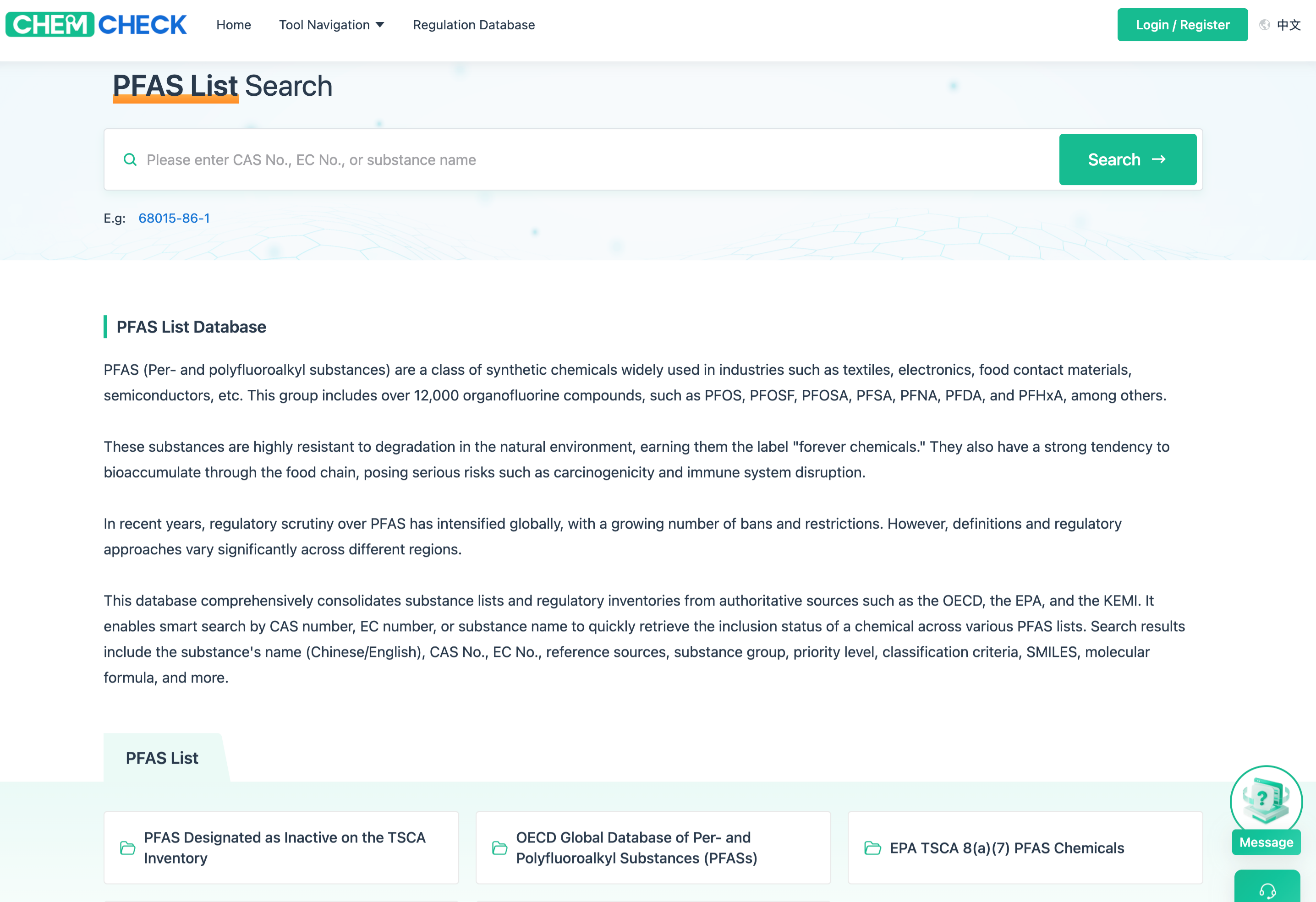
Faced with this tangled web of PFAS lists, the ChemCheck platform (chemcheck24h.com) has launched a PFAS Inventory Query Service to help companies complete compliance self-checks in one stop:
✅ Integration of authoritative data: Consolidates multiple authoritative inventories including the OECD global database, the U.S. EPA TSCA 8(a)(7) list, the U.S. inactive PFAS list, Sweden's PRIO database, and the EPA structural list
✅ Multi-dimensional search: Supports flexible queries by CAS number, EC number, or substance name
✅ One-click comparison: Enter the substance information and instantly view its listing status across all authoritative inventories, allowing quick identification of its PFAS regulatory status
The tool adopts an inventory-based query model, with all data sourced from official lists published by authoritative agencies. For agrochemical companies, it is particularly useful in the following scenarios:
Export compliance: Quickly confirm whether an active ingredient or metabolite is included on various jurisdictions' PFAS lists, and anticipate compliance risks when exporting to markets such as the EU and the U.S.
Registration support: Provide authoritative data support for PFAS-related declarations in pesticide registration dossiers
Supply chain screening: Conduct systematic compliance screening of fluorine-containing substances across existing product lines
❗ Special reminder: Not on the list ≠ Not a PFAS.
The coverage of an inventory query depends on how comprehensively each authoritative list has been compiled, so a negative result does not mean that a given pesticide is not a PFAS. Companies still need to combine the OECD or EPA definitional criteria with further analysis of the substance's chemical structure. To address this pain point, we are developing an automated PFAS determination tool based on chemical structure. In the future, users will be able to input a molecular structure directly and automatically determine whether it meets the PFAS definition in each jurisdiction. Stay tuned.
Try the PFAS Inventory Query now.
About ChemCheck
ChemCheck is REACH24H's integrated compliance query platform. Starting with industrial chemical queries, it now offers a range of services, including the Global Chemical Inventory, FCM list, PFAS list, GHS hazard classification, CAS substance database, and dangerous goods transportation queries, and has expanded into the agrochemical field (pesticide registration database). We will continue to roll out more agrochemical compliance query functions — stay tuned.



Most Popular
- 1 South Korea Issues Guidelines on Establishing Biocidal Product Names, Clarifying Rules on Identical Names, Additional Names, and Prohibited Expressions
- 2 Brazil Launches Sispa: A Unified Digital Platform for Pesticide Registration
- 3 Vietnam to Officially Abolish Quality Pre-Inspection for Imported Fertilizers Starting July 1
- 4 EU Imposes Strict Regulatory Measure: 12 Pesticide Co-formulants Added to Banned List
- 5 California Releases New Regulation on Groundwater Protection List: Added 51 New Active Ingredients